You can’t buy a domain name forever. ICANN caps every registration at 10 years. But you can keep a domain indefinitely by enabling auto-renewal with a registrar like Namecheap ($6.49 first year, $15.98 renewal) or Cloudflare ($10.44/yr at cost), or by minting a one-time blockchain domain through Unstoppable Domains (starting at $5, no renewals ever). This guide walks you through 3 methods with 23 screenshots, step by step.
- A credit card, PayPal account, or cryptocurrency wallet for payment
- An idea for the domain name you want to register
- A valid email address for account creation and WHOIS records
- 5 to 15 minutes to complete the registration process
What Is Buying a Domain Name Forever?
Buying a domain name “forever” means keeping continuous ownership of a web address like yourbusiness.com without ever losing it to expiration. The global domain name market reached $10.49 billion in 2026, according to Business Research Insights, and it’s growing at 5.1% per year through 2035.
Here’s the thing: you don’t actually “buy” a domain the way you buy a car or a house. You lease it. According to ICANN (the Internet Corporation for Assigned Names and Numbers), every domain registration is a time-limited agreement between you and a registrar. That lease runs anywhere from 1 to 10 years.
As of Q4 2025, the Verisign Domain Name Industry Brief reports 386.9 million domain name registrations worldwide. Out of those, 173.5 million are .com and .net domains combined. That’s a lot of people “renting” their online identity.
So when people search “how to buy a domain name forever,” they’re really asking: how do I make sure I never accidentally lose my domain? There are 3 practical answers, and this guide covers all of them with screenshots.
Why You Can’t Truly Own a Domain Name Permanently
ICANN sets a hard 10-year cap on every domain registration. No registrar (GoDaddy, Namecheap, Cloudflare, or anyone else) can sell you a .com for more than 10 years at once. This rule exists in ICANN’s Registrar Accreditation Agreement and applies to all generic top-level domains.
The reason is simple. ICANN wants to prevent domain hoarding and make sure domain owners stay accountable. When your 10-year term ends, you must renew, or the domain goes back into the public pool.
Big companies have lost their domains by forgetting to renew. In 2015, ex-Google employee Sanmay Ved bought google.com for just $12 when it briefly expired. Google paid him $6,006.13 to get it back. Foursquare’s entire $80 million platform went offline in 2010 after a missed renewal. And Regions Bank, the 22nd largest U.S. bank, lost online banking access for nearly a week in 2013.

The Google.com incident is the perfect example of why domain expiration protection matters. If Google (a trillion-dollar company) can slip up, any business can too.
Country-code domains like .uk, .de, or .ca sometimes have different rules set by their local registry operators, but the principle stays the same: you’re leasing, not owning.
No traditional domain registrar can sell you a domain for more than 10 years. The solution is auto-renewal (keeps renewing automatically as long as your payment method works) or blockchain domains (one-time purchase, no renewals). Both methods are covered below.
Method 1: Buy a Domain Name Permanently with Unstoppable Domains (5 Steps)
Unstoppable Domains is the only registrar that sells true one-time-purchase domains with zero renewal fees. Prices start at $5 and go up to $1,000+ for premium names. These domains are NFTs minted on the Ethereum and Polygon blockchains, which means once you own one, it’s yours forever with no ongoing payments.
There’s a catch, though. These blockchain domains (extensions like .crypto, .nft, .wallet, .blockchain, .x, .bitcoin) don’t work in regular web browsers the same way .com does. Visitors need a compatible browser or extension to access blockchain domain websites. For crypto wallets and Web3 apps, they work great. For a standard business website, you’ll still want a .com alongside it.
Unstoppable Domains also offers .com domains, but those follow standard ICANN rules (10-year max, renewals required). Only the blockchain-native extensions are truly permanent.
Step 1. Go to the Unstoppable Domains Website
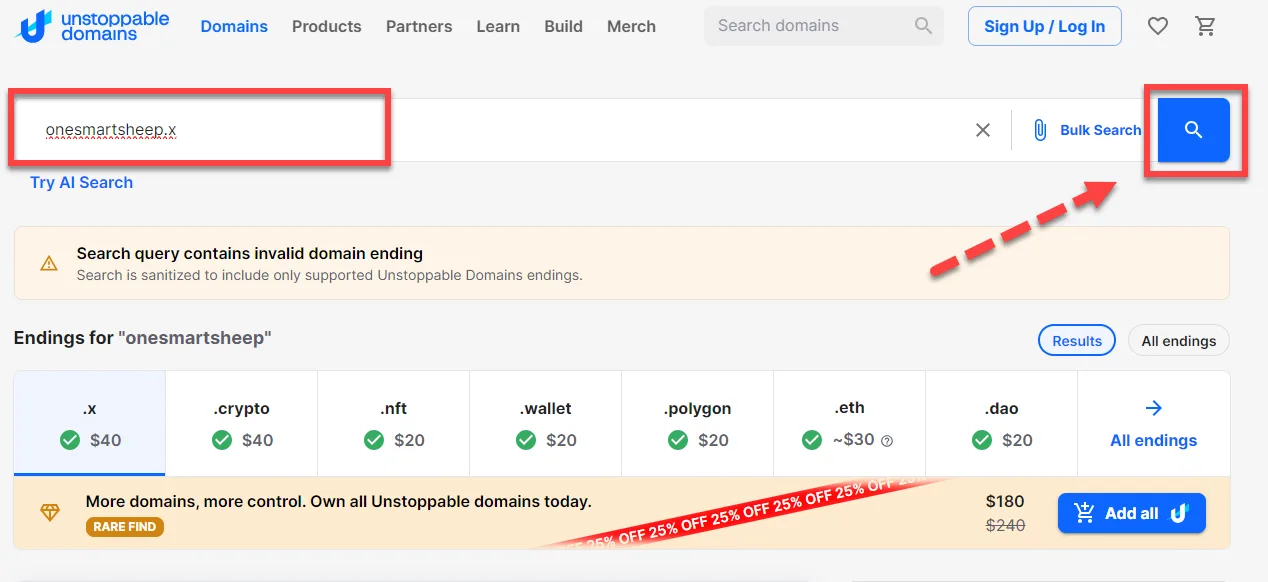
Open the Unstoppable Domains website in your browser. You’ll see a search bar on the homepage where you can type your desired domain name. All blockchain domain extensions (.crypto, .nft, .wallet, .x, .bitcoin, .dao, .blockchain, .888) are available for permanent purchase. The .com and .eth extensions have a 10-year limit.

Step 2. Check the Availability of Your Domain
Type the domain name you want into the search box and click the search icon. The results page shows which extensions are available and what each one costs. A standard 5-character name on the .crypto extension typically costs between $20 and $40. Shorter names cost more.

Step 3. Add the Domain to Your Cart
When you find an available domain, click “Add to Cart.” Keep in mind that adding a domain to your cart doesn’t reserve it. Other buyers can still purchase the same domain until you complete checkout. If you’re buying a popular name, move through the process quickly.

Step 4. Open Your Cart and Review the Order
Click on the cart icon to see all domains you’ve selected. The order summary shows the subtotal for each domain plus the Unstoppable Vault fee (typically around $4). This vault fee covers storing your NFT domain on the blockchain. Review the total and click “Checkout Cart” to continue.

Step 5. Choose Your Payment Method and Complete Purchase
Unstoppable Domains accepts 4 payment methods: credit/debit card, PayPal, cryptocurrency, and Crypto.com Pay. Pick your preferred option, enter the payment details, and click “Submit Payment.” After payment, the domain is minted as an NFT and transferred to your wallet. No renewal emails, no expiration dates, no annual fees.

If you want full privacy for your domain purchase, blockchain domains are inherently anonymous since they’re tied to a crypto wallet address, not your personal name. For traditional .com domains purchased anonymously, read our guide on How to Buy a Domain Name Anonymously.
Method 2: Keep a Domain Name Forever with Namecheap’s Auto-Renewal (8 Steps)
Namecheap’s top-up and auto-renewal system is the most practical way to “own” a traditional .com domain indefinitely. You add funds to your Namecheap account, register a domain, enable auto-renewal, and Namecheap automatically renews the domain before it expires. As long as your account has enough balance, the domain stays yours.
A .com domain on Namecheap costs $6.49 for the first year and renews at approximately $15.98/year. That works out to about $150 per decade. If you add $200 to your account balance today, you’ve effectively “bought” your domain for the next 12+ years without thinking about it.
Step 1. Create a Namecheap Account (or Sign In)
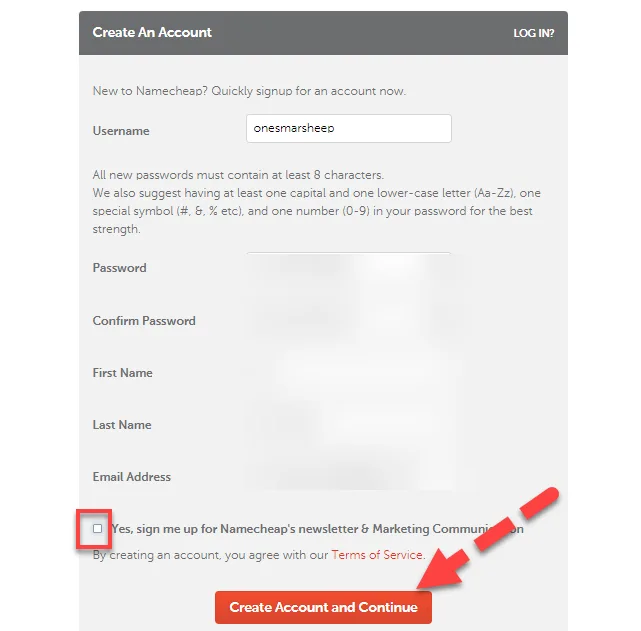
Go to Namecheap.com. If you already have an account, click “Sign In” at the top right. New users click “Sign Up” and enter an email address, username, and password. Click “Create Account and Continue” to finish registration.
Step 2. Add Funds to Your Namecheap Account
From your Namecheap dashboard, find the “Account Balance” box and click the “Top Up” option. This opens the funding page where you can add money to your account. Namecheap accepts 3 payment methods for top-up: credit/debit card, PayPal, and Bitcoin.
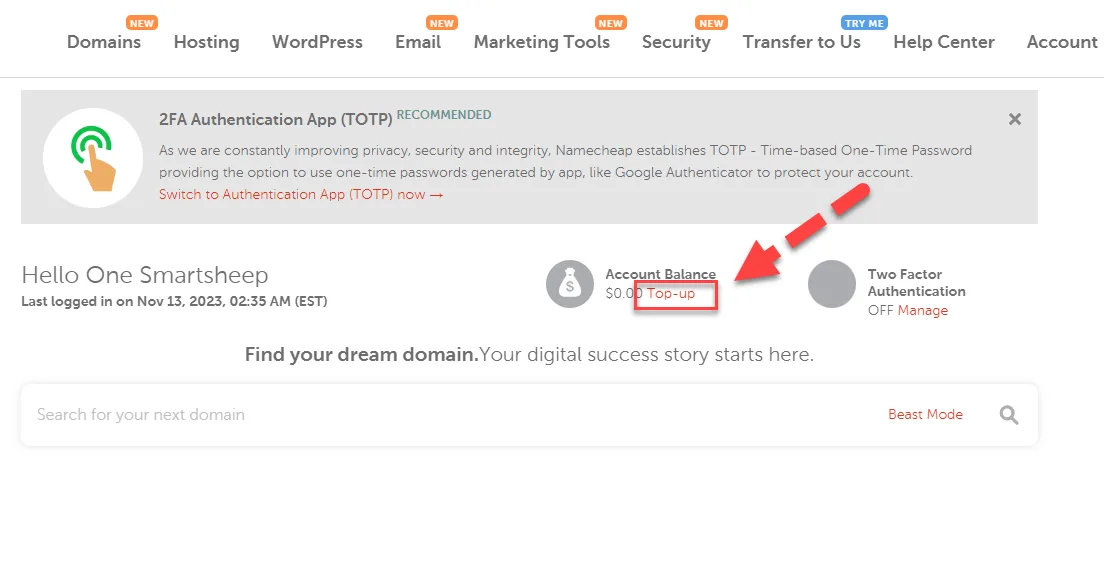
On the top-up page, you’ll see your current account balance. Select your preferred payment method. We’ll use card payment for this walkthrough. Click “Next” to proceed.

Enter the dollar amount you want to add. Think about how many years of renewals you want to cover. At roughly $16/year for a .com, adding $100 covers about 6 years of automatic renewals. Click “Next” after entering the amount.

Step 3. Enter Your Billing Details and Confirm Payment
Fill in your card details along with billing information: first name, last name, street address, city, zip code, state/province, and country. Click “Next” to review everything.
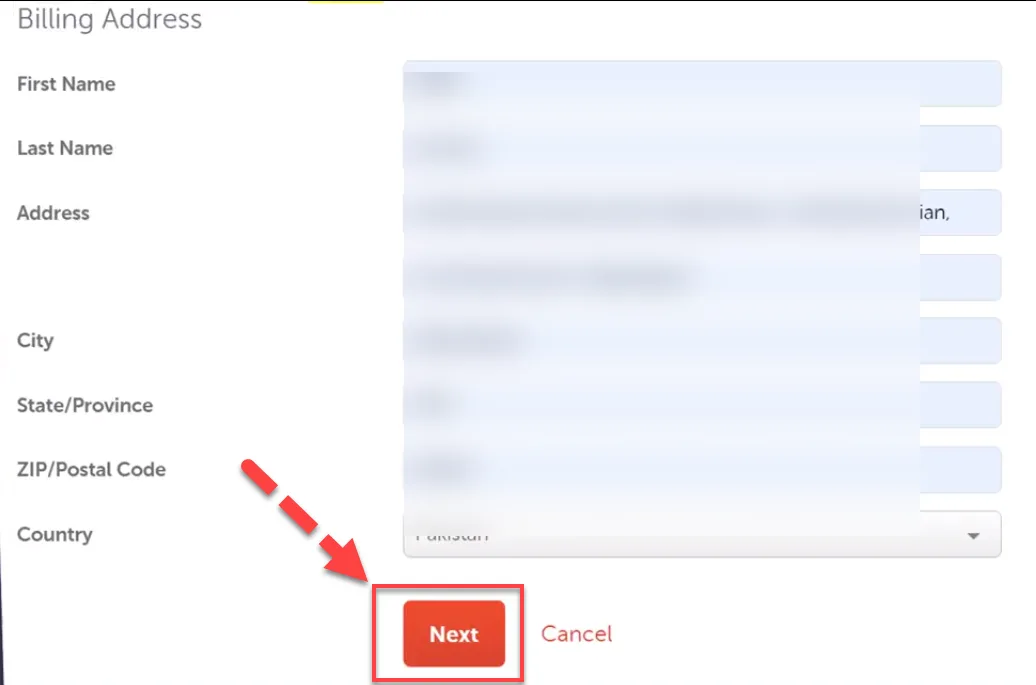
On the confirmation screen, double-check the amount and your card details. Click “Charge and Proceed” to add the funds to your Namecheap account. The money appears in your balance immediately.


If you’re using a platform like Wix instead and want to know about domain management there, check out How to Change Domain Name on Wix for a complete walkthrough of connecting custom domains.
Step 4. Search for Your Domain Name
Now that your account has funds, it’s time to find your domain. Type your desired domain name into Namecheap’s search bar and click the search icon. The results show whether your exact domain is available. If it is, you’ll see a green checkmark. If not, Namecheap suggests alternatives.

Click “Add to Cart” next to any available domain you want to register.
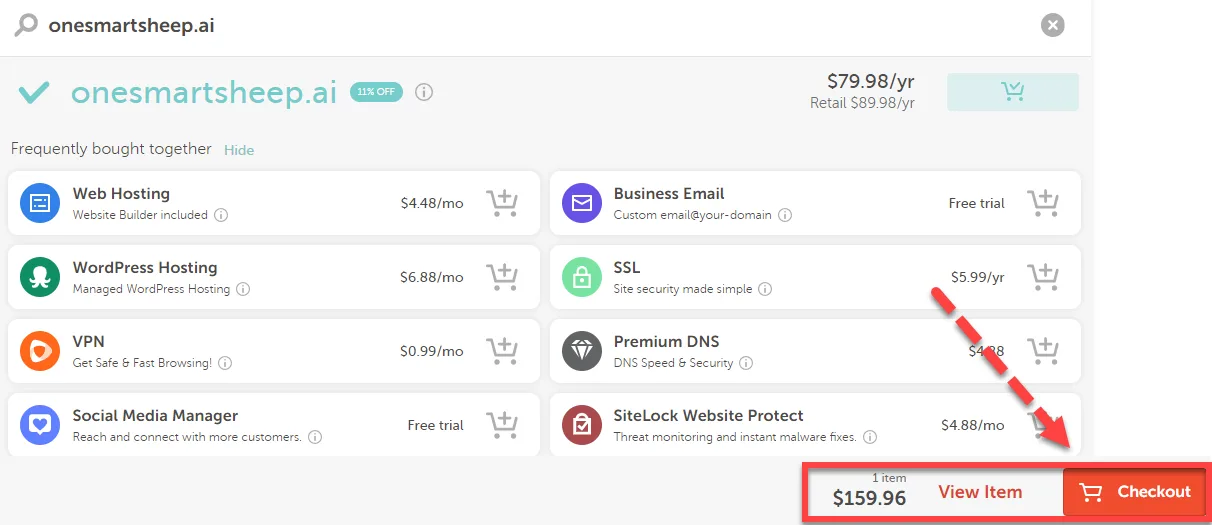
Step 5. Proceed to Checkout
After adding your domain to the cart, a checkout button appears at the bottom of the page. If you don’t need additional domains, click “Checkout” at the bottom right to move to the payment screen.

Step 6. Select Your Registration Period
Namecheap lets you register a domain for 1 to 10 years at checkout. Choosing 10 years gives you the longest stretch before your first renewal. According to ICANN rules, 10 years is the maximum allowed registration period for any domain registrar. Pick the timeframe that fits your budget.

“The maximum remaining unexpired term shall not exceed ten years. Registrars offer initial and renewal registrations in one-year increments up to this cap.”
Source: ICANN Registrar Accreditation Agreement
Step 7. Enable Auto-Renewal for Your Domain
This is the most important step for keeping your domain forever. At the top of the checkout page, click “Bulk Settings” to open the auto-renewal options. You’ll see two choices: enable auto-renewal for all eligible domains, or disable it. Choose “enable.”
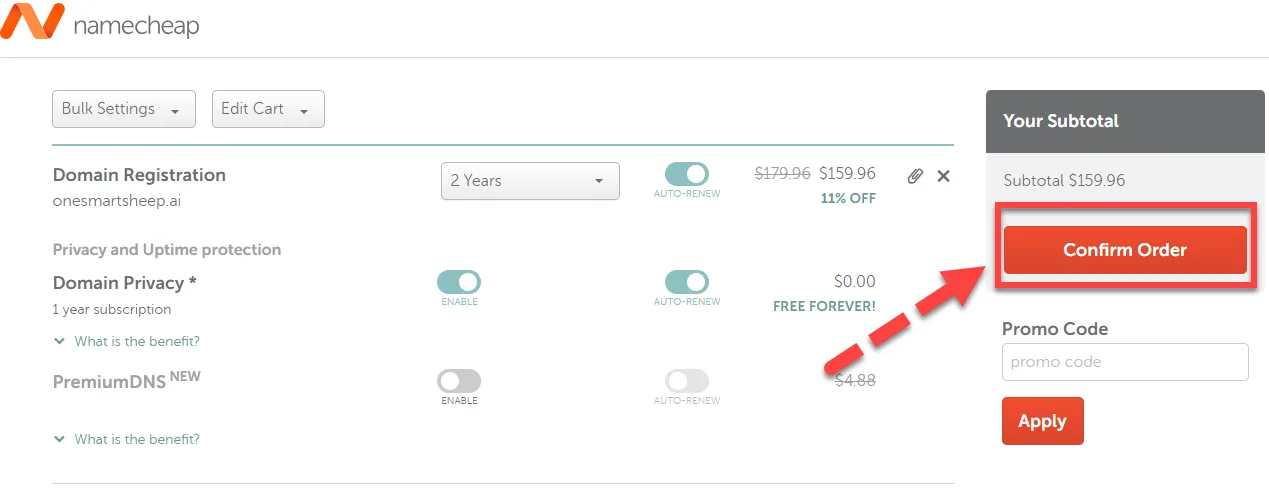
With auto-renewal turned on, Namecheap automatically deducts the renewal fee from your account balance before the domain expires. As long as your account has funds, the domain renews itself year after year. No manual action needed.
Step 8. Confirm Your Order and Complete Payment
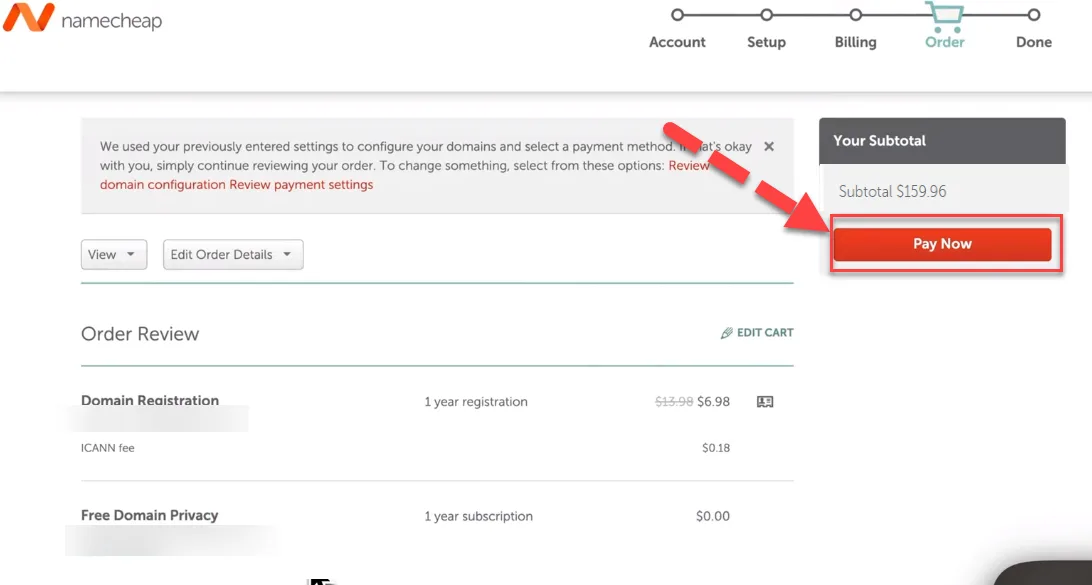
Verify that the auto-renewal toggle is turned on, then click “Confirm Order.” On the next screen, click “Pay Now” next to your subtotal in the upper right corner. Namecheap deducts the registration cost from your account balance.
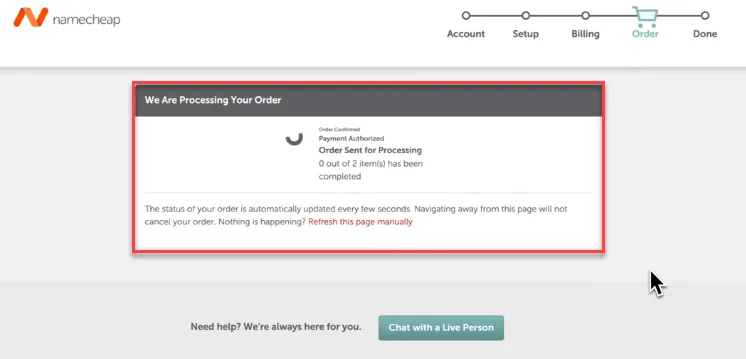
A notification pops up confirming that your order is being processed.
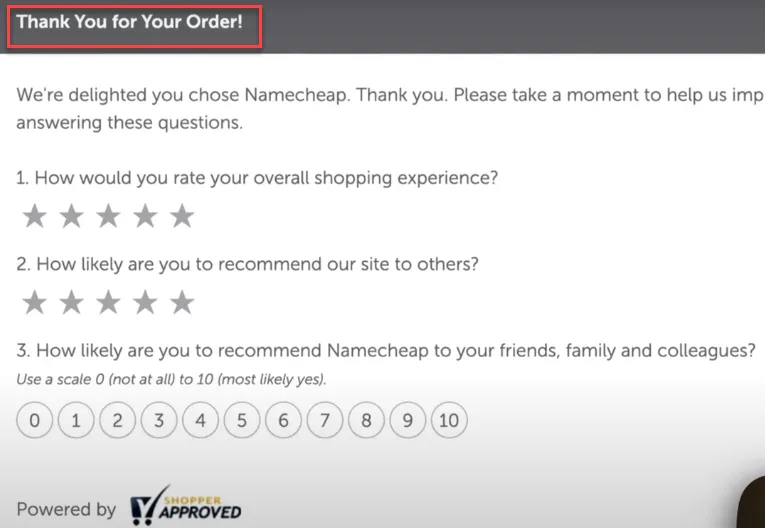
After a few seconds, you’ll see a “Thank You for Your Order” message. Your domain is now registered and set to auto-renew. Done.
After registering, check your domain every 6 months. Make sure the auto-renewal is still active, your payment method hasn’t expired, and your contact email is current. These 3 checks take 2 minutes and prevent the vast majority of accidental domain losses.
Method 3: Hire a Domain Management Service to Maintain Your Domain Forever
Domain management services handle all the technical details of domain ownership for you: registration, renewals, DNS configuration, WHOIS privacy, and expiration monitoring. These services are best for businesses managing 10+ domains or companies that can’t risk a missed renewal.
Most domain management providers charge a monthly fee. Costs range from $50 to $500+ per month depending on the number of domains and the level of service. For a single domain, that works out to $600 to $6,000 per year, which is far more expensive than self-managing on Namecheap ($16/year). But for companies with large domain portfolios, the peace of mind is worth it.

These providers typically include: automatic renewal management, DNS hosting and configuration, brand protection monitoring (alerts when someone registers a similar domain), domain acquisition services, and 24/7 technical support.
Popular domain management providers include MarkMonitor (enterprise-level, used by Fortune 500 companies), CSC Digital Brand Services, and Gandi Corporate Services. For small businesses, a simpler approach like Namecheap’s auto-renewal (Method 2) usually works fine.
Building a website on your new domain? Our guide on 10 Huge Reasons Not to Use Wix for Business Websites explains why platform choice matters as much as your domain name. And if you’re already on Wix and wondering about costs, see How Much Wix Designers Charge for real pricing data.
Domain Registrar Pricing Comparison: Who Charges What in 2026
6 registrars dominate the .com domain market in 2026. Their prices range from $10.44 to $21.99 per year for renewals. The difference adds up fast: choosing Cloudflare over GoDaddy saves you $115 over 10 years on a single .com domain.
| Registrar | First Year | Renewal/yr | 10-Year Cost | Free WHOIS | Auto-Renew |
|---|---|---|---|---|---|
| Cloudflare | $10.44 | $10.44 | $104 | Yes | Yes |
| Porkbun | $10.33 | $11.08 | $110 | Yes | Yes |
| Namecheap | $6.49 | $15.98 | $150 | Yes | Yes |
| Squarespace Domains | $14.00 | $14.00 | $140 | Yes | Yes |
| GoDaddy | $11.99 | $21.99 | $210 | $9.99/yr | Yes |
| Unstoppable Domains | $5 to $1,000+ | $0 (Never) | $5 to $1,000+ | N/A (blockchain) | N/A |
Cloudflare is the cheapest long-term option at $10.44/year because they sell domains at wholesale cost with zero markup. But Cloudflare requires you to use their DNS infrastructure. Porkbun offers a similar flat-rate model at $11.08/year with more DNS flexibility. Namecheap’s low first-year price ($6.49) jumps to $15.98 at renewal, while GoDaddy charges the most at $21.99/year.
According to a 2026 comparison by CyberNews, Namecheap’s renewal rates are 20 to 40% lower than GoDaddy’s across all domain types. But Cloudflare’s at-cost pricing beats both by 30 to 40%.
What Happens When a Domain Name Expires? The 75-Day Timeline
Domain expiration follows a 75-day cycle with 4 distinct phases. Understanding this timeline helps you recover a domain if you miss a renewal, or avoid losing it permanently.
Phase 1: Grace Period (Days 1 to 45)
According to ICANN policy, registrars must provide an Auto-Renew Grace Period of 45 calendar days after a domain expires. During this window, you can still renew at the standard renewal price. Your website goes offline during this period, but you haven’t lost the domain yet.
Phase 2: Redemption Period (Days 46 to 75)
If you miss the grace period, the domain enters a 30-day redemption period. You can still get it back, but registrars charge a hefty redemption fee. At GoDaddy, the redemption fee is $80. At Namecheap, it’s around $110. This fee comes on top of the regular renewal cost.
Phase 3: Pending Delete (Days 76 to 80)
After redemption expires, the domain enters a 5-day “pending delete” status. Nobody can register or recover it during this time. ICANN uses this period for final administrative processing.
Phase 4: Public Release
After day 80, the domain drops back into the general pool. Anyone can register it for the standard first-year price. Domain investors watch for valuable drops daily using services like ExpiredDomains.net.
ICANN requires registrars to send 2 renewal reminders: one approximately 30 days before expiration and another about 7 days before. If you’re not receiving these emails, your contact information is outdated. Update it immediately in your registrar’s dashboard.
Speaking of websites going down, if you’re running WordPress, domain issues are just one thing that can break your site. Our guide on WordPress Permalinks Not Working covers another common problem that takes your pages offline.
5 Tips to Never Lose Your Domain Name
1. Register for the Maximum 10-Year Term
Paying upfront for 10 years reduces your risk of losing a domain compared to annual renewals. At Cloudflare’s wholesale rate of $10.44/year, a 10-year registration costs $104.40, roughly the price of 2 nice dinners out. Lock it in and forget about it for a decade.
2. Enable Auto-Renewal on Every Domain You Own
Auto-renewal is free at every major registrar. Turn it on immediately after registering a domain. According to ICANN’s FAQ for registrants, auto-renewal is the single most effective way to prevent accidental expiration.
3. Keep Your Payment Method Updated
Auto-renewal fails if your credit card expires. Set a calendar reminder every 12 months to verify your payment details in your registrar account. Some registrars like Cloudflare and Namecheap send you an alert when a payment method is about to expire.
4. Use a Dedicated Email for Domain Management
Don’t register domains with a personal email that you might stop checking. Use a permanent business email (like [email protected]) and make sure someone monitors it. Renewal notices and expiration warnings go to this address.
5. Add Domain Lock (Transfer Protection)
Domain lock prevents unauthorized transfers. If someone gains access to your registrar account, they can’t move your domain to another provider without first removing the lock. Every registrar offers this for free, and it’s usually enabled by default.
If you own a business website, set up domain monitoring through a service like DomainTools or WhoisXML. These tools send real-time alerts when your domain’s WHOIS records change, giving you an early warning if something looks wrong.
Managing a website involves more than just keeping the domain active. If you’re on WordPress, knowing How to Check WordPress Version (10 Easiest Ways) helps you stay on top of security updates. And for content management, learning How to Remove Author from WordPress Posts cleans up your site’s appearance.
Can You Buy a Domain Name Anonymously and Keep It Forever?
Yes, but the method depends on which type of domain you buy. Traditional .com domains require WHOIS information (your name, address, email, phone). Most registrars offer free WHOIS privacy protection that replaces your personal details with the registrar’s proxy information. Cloudflare, Namecheap, and Porkbun all include this for free. GoDaddy charges $9.99/year for it.
Blockchain domains through Unstoppable Domains are anonymous by design. They’re linked to a cryptocurrency wallet address, not your personal identity. There’s no WHOIS database for blockchain domains.
For a complete guide to domain privacy options, read our article on How to Buy a Domain Name Anonymously. It covers proxy services, offshore registrars, and privacy laws in detail.
What to Know About Domain Names on Website Builders
Many website builders like Wix, Squarespace, and Webflow include domain registration in their premium plans. But “free” domains through these platforms come with strings attached. If you cancel your subscription, you usually lose the domain (or face extra steps to transfer it).
The safer approach is to buy your domain separately from a dedicated registrar (Cloudflare, Namecheap, or Porkbun) and then connect it to your website builder. This way, you control the domain independently of your hosting platform.
If you’re currently on Wix and considering a switch, our analysis of Why Is Wix So Slow and How to Cancel Wix Subscription covers what you need to know about moving away from the platform while keeping your domain.
Already using Wix and need to customize it? Adding custom code like popups can be tricky on website builders. Check out How to Add a Popup on Wix if you need help with that specific feature.
For WordPress users who need to put their site into temporary offline mode during domain transitions, our guide on WordPress Maintenance Mode Without a Plugin (5 Ways) walks through the process without any extra plugins.
Frequently Asked Questions
Can I buy a domain name permanently?
No, not through traditional registrars. ICANN limits all domain registrations to a maximum of 10 years. You must renew after each term. The only exception is blockchain domains from providers like Unstoppable Domains, which cost a one-time fee of $5 to $1,000+ and never require renewal. For traditional .com domains, enabling auto-renewal with a registrar like Namecheap or Cloudflare is the closest you can get to permanent ownership.
How much does it cost to keep a domain name forever?
$10 to $22 per year depending on your registrar. Cloudflare offers the cheapest .com renewals at $10.44/year (wholesale cost, no markup). Over 10 years, that’s about $104. GoDaddy costs the most at $21.99/year ($220 over 10 years). Blockchain domains from Unstoppable Domains are a one-time purchase starting at $5 with no annual fees, but they don’t work the same as traditional .com domains in standard browsers.
What happens if I forget to renew my domain name?
Your website goes offline, and you have about 75 days to recover it. The first 45 days are a grace period where you can renew at the normal price. Days 46 to 75 are a redemption period where recovery costs $80 to $110 extra. After day 80, the domain becomes available for anyone to register. Companies like Google, Foursquare, and Regions Bank have all accidentally let domains expire.
Is Unstoppable Domains worth it for a business website?
Not as your primary domain. Blockchain domains (.crypto, .nft, .wallet) don’t resolve in standard browsers without special extensions. For a business that needs customers to find you online, a traditional .com is still the best choice. Unstoppable Domains work well as a secondary domain for cryptocurrency payments, Web3 applications, or future-proofing. Most businesses should register a .com through a standard registrar and add a blockchain domain if needed.
Which domain registrar is best for long-term ownership?
Cloudflare is the cheapest at $10.44/year with no renewal price hikes, free WHOIS privacy, and free SSL certificates. The trade-off is that you must use Cloudflare’s DNS. Porkbun ($11.08/year) is the best option if you want affordable pricing with DNS flexibility. Namecheap ($6.49 first year, $15.98 renewal) offers a great signup deal but costs more long-term. All three include free WHOIS privacy and auto-renewal.
Can I transfer my domain to a cheaper registrar?
Yes. Domain transfers are available after the first 60 days of registration. The process takes 5 to 7 days and typically costs one year of registration at the new registrar (which gets added to your existing term). For example, transferring a .com from GoDaddy ($21.99/year) to Cloudflare ($10.44/year) saves you $11.55 per year going forward. You’ll need an authorization code from your current registrar and the domain must be unlocked before initiating the transfer.